|
©The Archaeological Settlements of Turkey - TAY Project
|
|
|
|
|
|
Sarhöyük / Dorylaion |
|
|
For site maps and drawings please click on the picture... 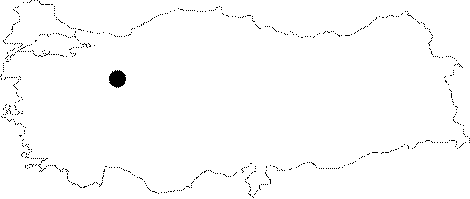 |
For photographs please click on the photo... 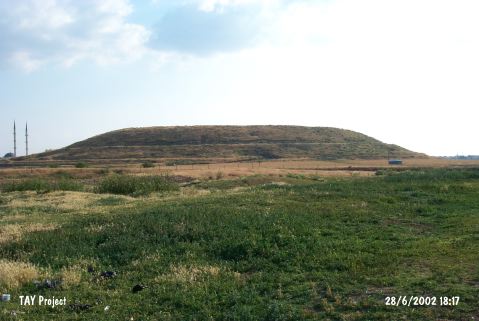 |
|
Type:
|
Mound |
|
Altitude:
|
814 m |
|
Region:
|
Central Anatolia |
|
Province:
|
Eskisehir |
|
District:
|
Merkez |
|
Village:
|
Muttalip |
|
Investigation Method:
|
Excavation |
|
Period:
|
Middle Phrygian Late Phrygian Early Phrygian |
|
|
|
  |
|
| Location: The ancient city of Dorylaion, modern Sarhöyük, is situated on the southern edge of a plain to the north of the Porsuk Brook, 2 km from Porsuk Brook near the Muttalip Subdistrict, 3 km northeast of the provincial center of Eskisehir. According to the ancient resources, it is a Phrygian city founded by Dorylaeus of Eretria. |
| Geography and Environment: Sarhöyük-Dorylaion is a crossroads of primarily important routes that provide access from the Central Anatolia to the Marmara Sea, the Aegean shores and the Mediterranean Region. It is referred as a prosperous trading city renowned with its thermal waters. It has a height of 18 m and a diameter of 450 m, and it is one of the moderate sized mounds of the Central Anatolia. It has been heavily destroyed by the pits dug for artillery batteries in Eskisehir during the Independence War. |
| History: |
| Research and Excavation: First excavations at Sarhöyük were initiated by M. Darga in 1989. In 2005 T. Sivas took over and conducted excavations until 2012. Since 2012 Directorate of Eskisehir Museum has been excavating at the site. Sarhöyük is listed as an officially registered archaeological site by the Ministry of Culture and Tourism. |
| Stratigraphy: The archaeological finds revealed at excavations on the hilltop and the northern, western and southern sections of the mound indicate presence of the Ottoman, Byzantine, Roman, Hellenistic, Classical, Phrygian and Hittite Period settlements as well as the Early Bronze Age culture. |
| Small Finds: Architecture: The soundings in trench I14 on the western slope and step-trenches R6-8 on the northern section yielded domestic buildings from the Phrygian Period. A workshop, housings of wooden pillars supporting the roof, a tandoor, and a sewage pit were uncovered in the courtyard of a Phrygian domestic building on steps 3 and 4 of the step- trench. The trench I14 yielded a rectangular room of a two phase domestic building. A 0.2 m wide and 2 m long wooden pillar, supporting the ceiling of the room, which was delimited by weak foundations of two courses of 0.3 m wide stones, was brought to the light as collapsed onto the floor. Recovery of gray sherds, pithoi and large size spindle whorls belonging to the Middle Phrygian Period within a deposit of a domestic building in trench R7 suggest presence of a Middle Phrygian settlement here. Furthermore, abundant number of gray Phrygian sherds were recovered from the room in I 14. The levels 2-6 of the six building levels identified in trenches H14 and G14 in the western section were dated to the Middle Phrygian Period based on the architectural an ceramic data. Although the architectural remains do not provide any precise information about the plan, the construction material composed of stones, mud bricks and mud plaster are similar to the ones in the neighboring Phrygian settlements. Between the building levels 2-6 are a Phrygian terrace wall and a stone pavement in front of it; a curved terrace wall in trench H14; a wall and a hearth under the terrace wall; stone and mudbrick wall remains unearthed in trench H14 and a portion of the stone pavement exposed in trench G 14 and a long stone wall, respectively. The excavations on the defense walls from the Middle Byzantine Period in trenches N/22-M/22 showed that these walls were built over the Phrygian cultural layer. It was found out that the wall uncovered inside the tower adjacent to the wall belonged to an earlier period and a portion of it stretches under the tower. The skeletons of puppies in a pithos uncovered here resemble the sacrificed puppies offered as votives to the mythical Lydian King Candaules, as an interesting find. These finds and accompanying black, bright sherds with graffito suggest that the Byzantine walls and tower penetrated into the Lydian cultural level (575-525BC). In the west trench, which is called Area B, remains belonging to Late Phrygian (550-334 BC) and Middle Phrygian (800-550 BC) were exposed below the Hellenistic level. Although the excavation area was quite limited in terms of size, the excavations carried out in the plan squares I13-I14, H13/14 and G13/14 yielded remains of a local Phrygian settlement. In this area, a house with two phases and its courtyard dated to the Late Phrygian Period were excavated. These structures were built behind a terraced wall. The house in rectangular plan has mudbrick walls with stone foundation and a single room. The interior faces of walls were plastered with soil. The floor of which is compressed earth floor. In the center of the room, there is a wooden post supporting the roof. This in situ wooden post measures 20 cm in diameter and 2 m in height. The courtyard is located to the east of the house. Inside the courtyard, rectangular hearths / ovens, siloi and rubbish pits were unearthed. In the same area, two building levels characterized by the local architecture of Middle Phrygian Period were determined about 1.50 below the terrace wall (H13/H14, G14) [Sivas-Sivas 2014:155]. Pottery: The sherds recovered from the Phrygian level are mainly in gray color. Trefoil jugs, crested bowls, kraters and dinoi, strainers, and large pithoi are among the most common vessel forms. The base, rim and body fragments of gray bowls with graffito are noteworthy, and represent an import group of finds. The wares belonging to the Late and Middle Phrygian levels generally consist of gray wares and common wares. In addition, quite high quality, imported Lydian wares (marble patterned painted vessels, lydia and lekythoi), Southwest Anatolian black vessels on red, Attic thin-walled wares (black figure and bright black burnished wares) and a group of potsherds bearing Phrygian graffiti were found [Sivas-Sivas 2014:155]. Seal: A terracotta seal found on surface ground near the step-trench R7 in the northern section of the mound proves presence of a Phrygian settlement on the mound. The Palaeo-Phrygian inscription on it consisting of 15 letters/characters is a dedication. The characters 11 through 15 phonetically give the pronunciation of "atiei" in dative case of the noun. The statement reading "To Atis" is a private name according to Brixhe, and it reminds a young relative of Phrygian goddess Cybele, Atis. A dedication was inscribed on the item which is in the form of a seal or a matrix [Brixhe 2002:4-10]. Bone/Antler: The trench M/22 yielded puppy skeletons in the interior of the Byzantine tower. |
| Remains: |
| Interpretation and Dating: |

