|
©The Archaeological Settlements of Turkey - TAY Project
|
|
|
|
|
|
Gre Dimse |
|
|
For site maps and drawings please click on the picture... 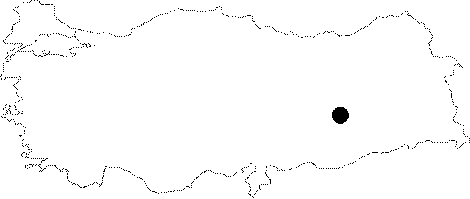 |
For photographs please click on the photo... 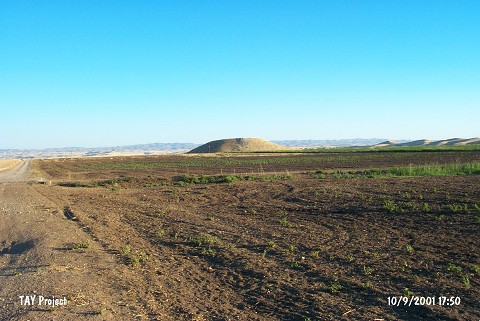 |
|
Type:
|
Mound |
|
Altitude:
|
500 m |
|
Region:
|
Southeastern Anatolia |
|
Province:
|
Diyarbakir |
|
District:
|
Bismil |
|
Village:
|
Köprü |
|
Investigation Method:
|
Excavation |
|
Period:
|
New Assyrian Empire Period Post Assyrian Period Early Iron Age Late New Assyrian Period |
|
|
|
  |
|
| Location: The site is located approximately 1.2 km north of the village of Köprü; east-southeast of Yukarisalat; east of the district of Bismil in the province of Diyarbakir. |
| Geography and Environment: |
| History: |
| Research and Excavation: After the brief survey performed in 1998, excavations were initiated under the direction of N. Karg, and with the supports of METU-TAÇDAM within the scope of the Salvage Project of the Archaeological Heritage of the Ilisu and Cardietnish Dam Reservoirs [Karg 2001:643]. It takes place in the registered archaeological sites list prepared by Ministry of Culture and Tourism. |
| Stratigraphy: The periods identified based on sherds found during 1999 campaign season: -Islamic Period-Medieval Age -Classical Period (Hellenistic-Roman): After 330 BC -Late Assyrian Period: Continued without interference and interruptions between levels most probably starting in 612 BC and Post-Assyrian Period (7th Century BC, and later) (the term "Post-Assyrian" was suggested by Wilkinson-Tucker for the period initiating in 612 BC which signifies the fall of Nineve and ending in 330 BC, the formation of Hellenistic Empire. This also includes Achaemenid and Meds Periods) -Neo-Assyrian Empire Period: ca. 9th century and 8th century BC (Middle Iron Age) -Early Neo-Assyrian Period: Late 2nd Millennium BC (12th and 10th Centuries BC) -Mitanni/Middle Assyrian Period [Karg 2001: 653-654]. |
| Small Finds: Architecture: The architectural element which is apparently a wall lying in west-northwest to east-southeast direction extending from the center of the field in eastern edge direction but ending before even reaching the edge, points out to the foundations of a building. The adobe brick buildings in the center of the field and at the end of the wall, lying perpendicular to the wall were observed. Pottery: Sherds unearthed inside trench D00/K20 dug over the mound are completely mixed into one another in every sense. The ceramics types consist of many early 1st Millennium BC specimens which bear Neo-Assyrian characteristics, as well as Hellenistic, Late Roman and Early Medieval Age specimens [Karg 2001:645]. The Late Post-Assyrian Period sherds unearthed at the mound, were matched to specimens from Assyrian settlements dated to the period after the fall of Nineve in 612 BC, and categorized under Late Assyrian specimens. Since most of Late Assyrian ceramics' types have a long extending tradition from 2nd Millennium BC and since these have survived with little changes even before Post-Assyrian periods, it is hard to name a certain date. It is a fact that the statements related to most of the sherds may be altered, unless small finds are found related with the existing sherds. The separation of real Assyrian sherds from its local imitations and the Assyrian pottery from the locally produced ware which are imitations of Neo-Assyrian (before Assyrian hegemony on Subria) specimens is a similar problem. Considering Neo Assyrian Empire period (Middle Iron Age: 10/9-8th Century BC) sherds 9-8th centuries BC levels have to be studied further, as also suggested by the condition of the excavated levels [Karg 2001:655, 657]. Early Neo-Assyrian Period (Early Iron Age: 12-10th centuries BC) sherds have characteristics in parallel with Norsuntepe and Korucutepe specimens [Karg 2001:657]. Grave: A burial was found after digging carefully deeper, which needs a more detailed definition. The burial consisted of a man's skeleton lying on his back. The arms and hands of the burial were crossed on his chest. Although mostly preserved, bones were very crisp and they shattered during unearthing. An animal skeleton was also found at the feet of the human skeleton, which possibly was a dog skeleton. A very rusty but well preserved sword was found lying next to the warrior's burial. The skeleton wore an iron ring on one of the fingers, and there were also six iron arrowheads besides the burial. A jug with the opening shut by a grove bowl was lying near the head of the warrior. The vessel was dark redish-brown painted figure decorated observable even inside and at the bottom of the vessel and belongs to the "Painted Ware" group often observed in late 2nd Millennium BC (Early Iron Age) Eastern Anatolia [Karg 2001:649-650]. Another bowl unearthed during excavations was grove decorated and was dated to North Mesopotamian Neo-Assyrian and later period [Karg 2002:705]. |
| Remains: |
| Interpretation and Dating: As a result of studies on sherds unearthed during 1999 campaign Neo-Assyrian Period related with Iron Age probably continued without intervention or interruption between 312 BC and Post-Assyrian periods' levels (7th Century BC and sometimes even later). The term "Post Assyrian" was suggested by Wilkinson-Tucker for the period initiating in 612 BC which signifies the fall of Nineve, and ending in 330 BC, the formation of Hellenistic Empire. This also includes Achaemenid and Meds Periods. On the other hand, as a result of comparisons against Üçtepe material, Neo-Assyrian Empire Period (9th and 8th Centuries/Medieval Iron Age) Gre Dimse finds clearly show the relation between Tigris and the area in the south [Karg 2001:669-670]. There were three known Late Middle Assyrian/Early Neo-Assyrian Kings who drove their military forces into Subria region. The most famous of these three was King Tiglath Pileser I (1114-1076 BC) which has his kingdom depiction at "Tigris Tunnel" near Lice and who wrote all his memories in detail in his annals. The others are Assur-bel-kala (1073-1056 BC) and Ashurnasirpal I (1049-1031 BC) who had the "White Obelisk" carved, and who is also the grandson of Tiglath Pileser. There are many clues to make the assumption that the warrior buried at Gre Dimse, is contemporary of these kings. The area north of Tigris most probably was controlled directly by Assyrians after Uppumu was looted by Esarhaddon in 673 BC. The local population having imported and imitated Neo-Assyrian forms long before, it is convincing to make the assumption the Neo-Assyrian pottery production was initiated after this date. Gre Dimse sherds reflect the particular geographical location between Anatolia and Assyria, thus providing us with a perfect opportunity for studying various interactions between the two cultural, political, ethnolinguistic formations [Karg 2001:660]. |

