|
©The Archaeological Settlements of Turkey - TAY Project
|
|
|
|
|
|
Kulaksizlar |
|
|
For site maps and drawings please click on the picture... 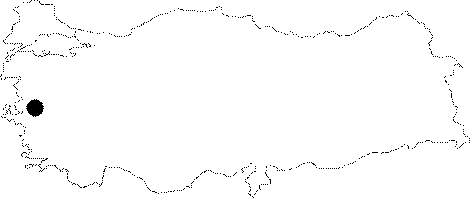 |
For photographs please click on the photo... 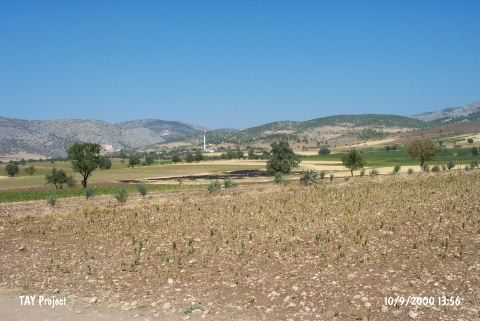 |
|
Type:
|
Workshop |
|
Altitude:
|
60 m |
|
Region:
|
Aegean |
|
Province:
|
Manisa |
|
District:
|
Akhisar |
|
Village:
|
Kulaksizlar |
|
Investigation Method:
|
Survey |
|
Period:
|
EBA I |
|
|
|
  |
|
| Location: The site lies northeast of the city of Manisa; west of the village of Kulaksiz which is 16 km southeast of Akhisar; in Balikburnu Mevkii between Kulaksiz Village and Akhisar-Gölmarmara road. Although it would be rather true to the fact to label the site as Balikburnu Mevkii; it is referred as Kulaksizlar; by the name of the village it is connected to; in the publications. |
| Geography and Environment: Marble idols; marble vessel pieces; idol cores; flakes; and sherds are scattered in an area of approximately 12 000 square meter. Harmandali Mountain lying in east-west direction is located north of Kulaksiz Village and Akselendi Plain is located west of it. There are current marble quarries in Harmandali Mountain. It is assumed that those who worked the atelier labeled Kulaksizlar were using the same quarries and were possibly settled in Balikburnu Mevkii. Approximately 5 km Northeast of Kulaksızlar Locality is Harmandalı marble quarry. This region contains the marble quarries that supply the marble requirement of antique city of Thyateira until Late Antique Age [Akdeniz 2010:69]. |
| History: |
| Research and Excavation: The site first came to be known when the villagers from Kulaksizlar took a marble idol and its pieces; recovered by chance; to Manisa Museum in 1991. The fields from which the finds came were first surveyed by R. Dinç in 1994 and then in 1995. The result of the first survey was 392 finds in two days. Today; it is assumed that many idols in the collections of the museums in Europe are of this origin. The surface is studied in 2007 and 2008 by E. Akdeniz [Akdeniz 2010:70].It takes place in the registered archaeological sites list prepared by Ministry of Culture and Tourism. |
| Stratigraphy: |
| Small Finds: Pottery: Sherds dating from the Chalcolithic Age to EBA were collected from the surface. Ground Stone: Plenty of Cilian type idols and fragments as well as sherds of marble vessels were recovered from the area identified as atelier. Cilian type idols start from the Chalcolithic Age and continue during EBA; therefore it is difficult to differentiate which ones are production of Chalcolithic Age or EBA. Some sherds verifying that the idols were produced here and revealing the production stages were collected. Marble quarries of the Harmadali Mountain were used for the raw material requirements. The finds are grouped into 8 by R. Dinç as follows; 1. Supports and stands in marble; 2. Idol heads and body fragments in marble; 3. Idol cores and models in marble; 4. Idol head models and finished idol heads; 5. Cilian type idol bodies; 6. Cup models and cups in marble (sherds); 7. screws and hammers in hematite; 8. Pumice stone scraping tools [Dinç 1997:257-263]. Also found are two idols identified as Troy style by R. Dinç. Having quadrangular bodies; round and flat heads and being made of schist rather than marble; those idols can be dated to the third millennium BC. The Kilya-type figurines unearthed by locals during the surveys carried out by E. Akdeniz in 2007 and 2008 are handed to Manisa Museum after cleaned up, photographed and sketched. The first one is a head piece of a marble figurine covered with heavy patina. The workmanship applied on the ear and the nose parts are very delicate. The other piece of marble is a torso (body). The art piece is broken from the neck and lower half of the body. And there are missing parts on the arms due to breaks. The piece catches attention with its thicker neck, lower shoulders and the body structure highlighted by engraving and it is similar to other samples located earlier in Kulaksızlar and to others from Aphrodisias Pekmeztepe and Yortan [Akdeniz 2010:72]. |
| Remains: |
| Interpretation and Dating: An excavation to be carried out in this workshop named after the nearest village as Kulaksizlar or Balikburnu Mevkii shall exactly reveal both the dating and characteristics of the site. Idol type named as Cilian type is suggested to belong to the Manisa region rather than Northwestern Anatolia. Idols produced had been sold both to the north and south by the atelier. Based on the sherds recovered inside the atelier; it was concluded that the production was; probably; dense during the Late Chalcolithic Age and drastically decreased during the EBA I. |

