|
©The Archaeological Settlements of Turkey - TAY Project
|
|
|
|
|
|
Keramos |
|
|
For site maps and drawings please click on the picture... 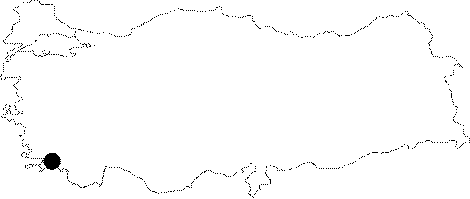 |
For photographs please click on the photo...  |
|
Type:
|
City |
|
Altitude:
|
m |
|
Region:
|
Aegean |
|
Province:
|
Mugla |
|
District:
|
Milas |
|
Village:
|
Ören |
|
Investigation Method:
|
Survey |
|
Period:
|
|
|
|
|
  |
|
| A 48 km dirt road from the Gökova/Akyaka Village runs by the northern shore of the Gökova Gulf, and reaches to Ören in front of the Kiran Mountains. Formerly Gereme, present Ören houses ruins of the ancient city of Keramos, also accessible by a 45 km asphalt road from Beçinkale. The artifacts that were collected from the Ören Village of the Milas District in Mugla and kept in the village school were taken to Bodrum in 1972. The artifact registered with inventory number 6520 is the torso of an athlete made of white marbel, standing with the left leg extending forwards from the Archaic Period. The upper portion of the body from the waist up, and the upper portion of the legs from the knee up are missing [Gürman 1974a:49], the remaining part of the sculpture is 35 cm high, 25 cm wide and 18 cm thick [Gürman 1977:111]. |
| Location: It is located in the Oren Village of the Milas District; southwest of the Mugla Province. It can be reached from Milas by car within one hour [Tirpan 1989:363]. |
| Geography and Environment: Flowing where the Mountain of Kiran; which is c. 600 m high; allows passage; the Karacay Brook forms a delta leading downward from the plateau. The river originates from the plateau. The water spills into the sea through underground ways. Located on a corner of the alluvial plain deposited by Karacay; it is most likely that Keramos was initially established on the shoreline [Bean 2000:36]. The shore to the west of Keramos is occupied by pebbled beaches interrupted with arable fields. To the east rises the Mountain of Kiran which does not allow passage until Akbük [Bean-Cook 1957:68]. It is known that Keramos; situated between Halikarnassus and Idyma was linked to Stratonikeia by a road passing through Panamara [Tirpan 1989:363]. |
| History: |
| Research and Excavation: |
| Stratigraphy: |
| Small Finds: |
| Remains: |
| Interpretation and Dating: |

