|
©The Archaeological Settlements of Turkey - TAY Project
|
|
|
|
|
|
Pedasa |
|
|
For site maps and drawings please click on the picture... 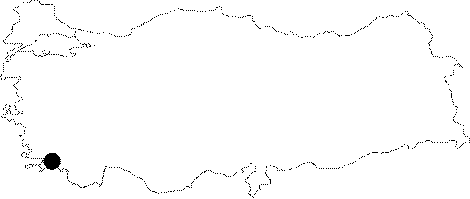 |
For photographs please click on the photo...  |
|
Type:
|
City |
|
Altitude:
|
m |
|
Region:
|
Aegean |
|
Province:
|
Mugla |
|
District:
|
Milas |
|
Village:
|
Gökçeler |
|
Investigation Method:
|
Excavation |
|
Period:
|
|
|
|
|
  |
|
| Pedasa is situated in a valley strait where the mountain system of the peninsula ends at Gökçeler, 4 km north of Bodrum. The remains of the city are accessible on a hill walking north from the stream spilling into the sea near the Agaçli Village of Bitez. Pedasa is densely covered with pine trees. A large threshold block was identified to the south of Hamasa Mevkii. A. Diler reported presence of remains from the Archaic Period around a building, which was probably sanctuary of the city on the acropolis of Pedasa, and they have been scattered around a result of illicit diggings. Remains of a civil settlements were found during the survey conducted within the territorium of Pedasa. Unslipped and coarse sherds dating to the Pre-Archaic Period were found around the threshold stone at Hamasa Mevkii [Diler 2004:143-155]. And remains of civil buildings and some sherds dating to the Late Geometrical Period were found on the upper eastern section of the stream bed running through the lower southeastern slope of the Çamtepe Hill to the south of the Pedasa acropolis. Also found are sarcophagi near these architectural remains, and they were dated to the 7th century BC [Diler 2005:137]. The 2009 excavations in the Sanctuary were conducted for the purpose of to find the northern continuation of the stone-paved road which begins from the direction of Acropolis, leads to the terrace of the temple where the monumental structure is located. The road continues towards the west. During the excavations carried out within this frame, no traces of road slab were encountered in Trench 1 and a structure measuring 4.10x4 m was exposed. In Trench 1, a stone-paved floor was encountered inside the structure. During the 2009 excavations pottery deposit in high density were found in the trench and most of them are dated to Archaic Period. In the excavation area, the light brown and partly red colored deposit with full of potsherds and chip stones were excavated at the uppermost elevations. Among these finds, there are vessels belonging to 4th century BC., Attic black-figure vessels belonging to Archaic Period, Ionian kylixesand a large amount of Caria vessels. The bedrock was reached on the west side of the sounding. There are finds belonging to Protogeometric and Geometric periods and 7th century BC. among the finds recovered from this area. A few finds found at the lower elevations show that the features of tile red paste and dense temper which are seen on Early IA pottery of the region have been continued [Diler (B. Özer) 2012:173-174]. During the 2012 studies carried out in the sector called Gökçeler Mevkii Area-3, two rectangular structures were exposed. These structures, which were named Structure I and II, extend in the east-west direction. The distance between them is 1.50 m. Structure I measures 8.30x13 m. Large blocks were used in its north and east walls and the south and west walls were built with small sized rectangular stone slabs. 3 urns and 1 pithos grave were found in this structure. In the Western Necropolis located to the slopes of Pedasa extending towards modern Konacik settlement, burial platforms were discovered. These platforms were used from the end of the 2nd millennium BC to the mid 7th century. The finds obtained from the graves MP 6 and MP 5 indicate the earliest occupation (the 12th-11th century BC) of Pedasa [Diler et al. 2014]. |
| Location: It is located in the Gokceler Village to the north of the Bodrum District of the Mugla Province [Bean 2000:115-116]. It is close to the village of Cirkan [Bean-Cook 1955:123]. |
| Geography and Environment: Situated in front of a narrow passage; it is reported to have been covered with pine trees during the researches carried out at the mid-20th century [Bean 2000:116]. The area stretching from the north of Goktepe and Konacik to the Torba port was presumably within the borders of the ancient city of Pedasa. Many Lelegian structures were found during the researches [Diler 2003:14-15]. |
| History: |
| Research and Excavation: |
| Stratigraphy: |
| Small Finds: |
| Remains: |
| Interpretation and Dating: |

