|
©The Archaeological Settlements of Turkey - TAY Project
|
|
|
|
|
|
Neandria |
|
|
For site maps and drawings please click on the picture... 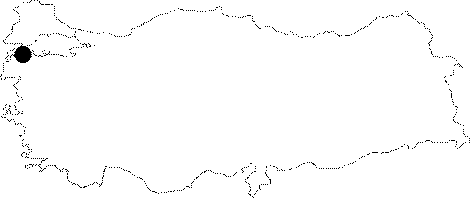 |
For photographs please click on the photo...  |
|
Type:
|
City |
|
Altitude:
|
m |
|
Region:
|
Marmara |
|
Province:
|
Çanakkale |
|
District:
|
Ezine |
|
Village:
|
Kocali |
|
Investigation Method:
|
Survey |
|
Period:
|
Archaic Classical |
|
|
|
  |
|
| Location: It was founded on the higher northwestern section of the Mount Çigri, the highest mountain in the region, 20 km southwest of the Ezine District in Çanakkale. |
| Geography and Environment: The city was founded on the higher northwestern section of the Mount Çigri. To the west of Çigri lies Alexandria Troas and its territory (locally known as Istanbulluk or Istanbuliçi) and to the northeast is the Plain of Ezine [Akarca 1977:5-6]. |
| History: |
| Research and Excavation: It was investigated in 1865 by F. Calvert, and in 1880 by J.T. Clarke, and lastly by R. Koldeway [Akarca 1977:7]. |
| Stratigraphy: |
| Small Finds: Architecture: As it is at a good distance off the modern settlements, the remains have survived to the present day; among them are city walls and temples. The temple built during the 6th century consists of a cella on a podium [Sevin 1999:68]. Excavated by Koldewey, this temple is the earliest temple known in Anatolia. The Archaic temple is known to have measured 9.34x20.12 m in dimensions with a single room [Akarca 1977:12]. It has capitals in Aeolic order. The Archaic city wall is 2.10-2.25 m thick, with every type of stones available. The height sometimes reaches up to 16.5 m. During the Archaic Period, there was also a primitive theatre, which only consisted of an orchestra. It was built on the slope, enclosed with walls on three sides. It measures approximately 15 m in diameter [Akarca 1977:17-24]. Considering the increased population, construction of a large city wall of ca. 3200 m should have been initiated during the 5th century [Akarca 1977:25]. Koldewey believed that this city wall was built by the Lydians around 550 BC [Winter 1985:680]. The city has two agoras built both during the Archaic and the Classical Periods. The earlier material recovered from the graves excavated in Neandria, a city which was founded by Aeolians in the Troad is dated to 700 BC. Neandria has a history of 400 years at most. It is believed that the city was abandoned during the late 4th century [Akarca 1977:8]. Pottery: The Archaic necropolis of Neandria yielded grey ceramics belonging to the 8th to 6th centuries BC [Polat 2002:193]. Coin: The first coins were minted in silver and bronze in 400 BC or somewhat earlier. They bear depictions of Head of Apollo and a grazing horse [Göktürk 1995:89]. |
| Remains: |
| Interpretation and Dating: |

