|
©The Archaeological Settlements of Turkey - TAY Project
|
|
|
|
|
|
Resadiye |
|
|
For site maps and drawings please click on the picture... 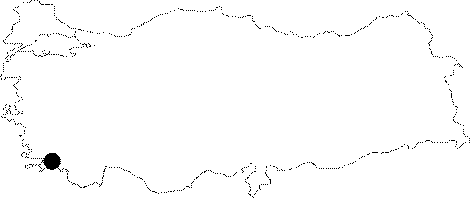 |
For photographs please click on the photo...  |
|
Type:
|
Workshop |
|
Altitude:
|
m |
|
Region:
|
Aegean |
|
Province:
|
Mugla |
|
District:
|
Datça |
|
Village:
|
Resadiye |
|
Investigation Method:
|
Excavation |
|
Period:
|
Roman Hellenistic Classical Archaic |
|
|
|
  |
|
| Location: Many pottery workshops were found during the researches in the Resadiye Village and its vicinity; located nearly 4 km northwest of the Datca District of the Mugla Province. |
| Geography and Environment: |
| History: |
| Research and Excavation: Besides the survey conducted by Bean and Cook in 1950; excavations were carried out by Tuna between 1986 and 1992. |
| Stratigraphy: |
| Small Finds: |
| Remains: Workshop: It is suggested that there are three findspots; presumed to have been workshops in an area of 2000 square meters 300 m east of Resadiye. Amphoras and common ware dating from the 1st century AD were uncovered in the southeastern section of the area; while amphoras with cork closures; and stamped amphoras dating from the 4th century BC were found in the southwestern parts [Tuna 1988:315]. A small hill; 200 m to the east yielded rectangular framed boukranian relief amphora seals as well as proto-Knidus seals dating from the second half of the 3rd century BC; and tools belonging to manufacturers (i.e.Astragalos; Mormis; Skirtos; etc.) who continued their production until the second half of 2nd century BC found [Tuna 1988:315]. Also; amphora fragments dating from the 7-6th century BC were recovered near the river bed to the south of the road to Hizirsah. Some of the handles are stamped. Probably of Rhodian origin; they might have been produced at the local workshops [Tuna 1988:315-316]. The excavations performed in the parcel #25 in Resadiye; revealed a well preserved kiln and its grill from the Hellenistic Period [Tuna 1990:556]. Also found here is a warehouse for stamped amphoras dating from the end of the 4th century BC; and beginning of the 3rd century BC. The firing chamber and heating channels of the 5 m wide kiln have also been preserved. Although there are traces suggesting the presence of a roof; no clue is available about the roof plan. The kiln; presumably built during the first quarter of the 3rd century BC at latest; seems not to have been used following the first half of the second century [Tuna 1990:556-557]. The entrance to the kiln is blocked by a wall in the east-west direction; which is consisting of irregular blocks plastered with clay; also constitutes the entrance chamber of another kiln (later than K1). The new kiln (K2) has been heavily destructed compared to the K1. It is larger than K1 and different in structure [Tuna 1991:156-157]. In the structures lying to the northeast and east of K1; some parts of the workshop installations and clay sedimentation tanks were unearthed. To the south of this area; a garbage pit was found; including materials; mostly dating from the end of the 4th century; and beginning of the 3rd century BC. Therefore; it was suggested that the waste material was not related to K1; but to an earlier kiln [Tuna 1990:557]. The excavations to the north of the kiln revealed also fine ware dating from the 6th century BC [Tuna 1991:156-157]. Depending on a seal dating to 210-188 BC; it is believed that the material has been related to a warehouse earlier than the abandonment of K1 [Tuna 1991:158]. The kiln F2 is 6 m long; and 3.6 m wide. The excavations revealed that the K2 is surrounded by a variety of walls; some dating to same years with K2; and some to a later period [Tuna 1992:192-193]. K2 revealed some amphora handles dating from 100-88 BC; bearing the stamps of the name of the manufacturer; Nikagoras. Based on these finds; it is presumed that the kiln was abandoned no earlier than the 1st century BC [Tuna 1991:158]. Consequently; it was noted that the kiln K2 belonged to a manufacturer called Nikagoras; and it was active under the eponyms of Dionysios ve Andromenes in the years 100-88 BC [Tuna 1991:166]. Clay Sedimentation Tank (Parcel#25; sector 1): As a result of the researches performed at this location; a clay sedimentation tank was found with a floor covered with small rubble stones. To the east of the tank lies a cistern [Tuna 1993:145-146]. The tank measures 9.1x14.5 m; and it presumably consisted of 3 phases; and was used for a long period of time. Following the analysis of the material from two garbage pits and a well as well as the presence of Nikagoras seals in relation with the eponym of Euphragoras (92-90 BC); it was concluded that the latest use of the sedimentation tank was parallel to the kiln K2 [Tuna 1994:150-151]. Installement structures (Parcel #41): A workshop; a garbage pit; deposited clay layer; and a floor plastered with powdered bricks; presumably a clay sedimentation tank were recovered here. It seems that the floor had been destroyed during the Byzantine Period. The material from the garbage pit is dated to the 3rd-2nd centuries BC. The newest material uncovered all overall the structure; is from the 1st century BC. However; some of the walls of the workshop are from a later period. Consequently it was concluded that the clay warehouse constituted the earliest phase; followed by the garbage pits crossing the clayed area; and dating to the 4th and 2nd centuries BC; and finally came the pottery workshop; partially standing on the garbage pit; dating to the 1st century BC as the third phase. The latter was destroyed during the Byzantine Period [Tuna 1992:193-195]. The manufacturers of Resadiye also produced common ware. Among the samples are olpe; lekane; inverted bowls; kalipter (kalipteros); mainly skyphos and small bowls [Tuna 1990:558]. Sector #3: Various pits were found; the largest one; A with a dimension of 4x3 m. The pits so called C and D yielded amphora fragments from the 3rd century BC while kiln material was recovered from the Pit A. Also found is an egg shaped cistern. The building made of stones and brick-dust cement is earlier than the pits. The interior was plastered with red clay [Tuna 1991:159]. The researchers believe that the Pits C and D are from a later period than the Pit A [Tuna 1992:193]. A big depot was found at the intersection of sector #3 and sector #1. A huge number of stamped amphora handles was uncovered [Tuna 1993:146-147]. Pear-shaped Kiln (Parcel #16;3): Smaller than the two kilns at 25/2; it was constructed inside a subterranean structure consisting of white; volcanic ashes called brick-dust. The plan resembles to the shape of a pear. It is encircled with a stone wall; with an entrance from the northwest. There is a cistern partly blocking the entrance; dating to a later period. A sounding performed next to the cistern yielded glaze fine potsherds and the bottom of an amphora with a ship prow. Another sounding performed at the kiln revealed glaze potsherds from the Hellenistic Period. The finds indicate that there was a production of fine ware as well as common ware and amphoras; and the kiln is dated to the 4th century BC [Tuna 1991:160-161; Tuna 1992:191]. Sector #4: A kiln's dump heap was found including mainly amphoras and fine ware [Tuna 1992:191]. Workshop of Damocrates: It is located on a hill to the immediate northwest of the highway [Tuna 1990:558]; southeast of the historical preservation zone extending to an area of approximately one square kilometer [Tuna 1988:314] at the Kiliseyani Mevkii of the Resadiye Village. Fragments of washing and cooking ware of a manufacturer called Damocrates and his successors were uncovered. The researches revealed material dating from the early 2nd and late 1st centuries. It is reported that these manufacturers were settled here following the hegemony of Rhodes; and lived until a production crisis arose due to the Mithridatic Wars in 88-85 BC [Tuna 1988:314; Tuna 1990:558-559]. The researches performed in 1989 revealed that the remains are under a fast vanishing process. The analysis in the section resulting from destruction revealed that the layers of cooking wastes developed as a result of the work of Damocrates and his successors in a period of nearly two hundred years [Tuna 1991:164]. Most of the material uncovered here during the excavations are stamped handled amphoras. Uninscribed stamps are available after 78 BC; which is likely to have been related with the Mithridatic Wars in 88-85 BC. Also found are seals of various governors ruled between 97-88 BC. The manufacturer of the vessels is Dioskourides; successor of Damocrates II [Tuna 1992:196]. Skirtos' Hill: It is located 500 m to the northeast of the Hill of Damocrates Hill. Following the surveys; it was found that rectangular framed boukhranian seals were used from the mid 3rd century until the second half of the 2nd century BC; and that the manufacturers called Skirtos; Mormis and Asklepeodoros worked at this workshop. The excavations revealed a northwest-southeast wall consisting of large blocks with a rough external surface [Tuna 1991:161-162]. It is apparently a terrace wall [Tuna 1992:190]. The layers of cooking wastes are among the finds. Also found are three human skeletons. The feet and head of skeleton #1 which was buried in the east-west direction; the head to the east; were covered with amphora fragments; and also small cups and plates were uncovered at the toe tips [Tuna 1991:162]. The second skeleton lies in the northeast-southwest direction; head to the northeast. The third skeleton; head to the southeast; lies in a pit in the nortwest- southeast direction. The skeleton's head is inside a large pot. Skeleton of an animal; probably of a dog; was found at the foot side. It is possibly dated to the second half of the 2nd century BC [Tuna 1991:166]. The analysis revealed that the production of pottery started from the Archaic Period; and the production of cnidian stamped amphoras started during the first quarter of the 4th century BC. It was found out that some of the amphoras and seals presumed to be of Rhodian origin were; in fact; originated from Cnidus. It seems that the systematic process started during the Hellenistic Period; continued during the Roman Period; and ended during the 7th century AD [Tuna 1989:142-143]. It is known that a broken limestone stele was found among the burial remains near the Resadiye-Hizirsah motorway; and used for the construction; which is currently at the Resadiye Primary School. It was inscribed with Stoichedon script. Based on the analysis on the inscription; it was suggested that it belonged to the first half of the 4th century BC. The inscription dedicated to Iphiades of Abydos is in Stoichedon style and uncovered near Datca. Iphiades seized Sestos and Parium in 360-359 BC; thus the inscription is probably dated earlier than 360 BC. The inscription is significant in elucidating the relationship between Cnidus and Hellespont during the first half of the 4th century BC. Additionally; fragments of several inscriptions were found and dated to the 4th century BC; and the Hellenistic and Roman Periods based on the scripts' style. The blocks; mostly re-used in buildings; are originally from steles and bases [Bean-Cook 1952:185-187; 189-191; 193]. |
| Interpretation and Dating: |

