|
©The Archaeological Settlements of Turkey - TAY Project
|
|
|
|
|
|
Theangela |
|
|
For site maps and drawings please click on the picture... 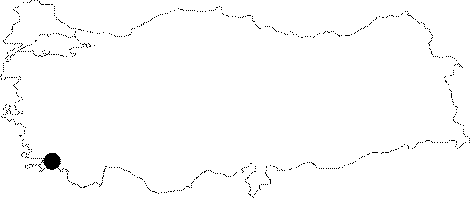 |
For photographs please click on the photo...  |
|
Type:
|
City |
|
Altitude:
|
m |
|
Region:
|
Aegean |
|
Province:
|
Mugla |
|
District:
|
Bodrum |
|
Village:
|
Etrim |
|
Investigation Method:
|
Survey |
|
Period:
|
Hellenistic Roman |
|
|
|
  |
|
| Location: It is accessible from a 9 km pathway through the woods from Etrim; one of the quarters of the Pinarbel Village to the east of the Bodrum District; west of the Mugla Province [Tirpan 1988:171]. |
| Geography and Environment: It is reported that the Ciftlik Valley to the south and Karaova to the north are included within the city's limits [Bean 2000:134]. |
| History: Although according to some researchers [Isik 1991:18] the finds recovered in the city indicate the 8th century BC; it is presumed that it was colonized by the immigrants from Troezen; a city in the Argolis of the continental Greece during the Hellenistic Period. It is known that the city was ruled by Pigres during the 5th century BC; and that she paid one talent tribute to the Delian League; and also the same person was involved in the Battle of Salamis in 480 BC as a captain of the Persian fleet. Potsherds dating to the end of the 5th century BC were uncovered in a vaulted grave; which is believed to have belonged to Pigres; who died in 427 BC. Mausolus reconstructed the city in the 4th century BC; and the population of the city increased with refugees. Theangela was assigned to Halicarnassus by Alexander the Great; and Eopolemus took the control of the city at the end 4th century BC. He went over Polemaios; the commander of Antigonos in 314 BC. Theangela's assignment to Halicarnassus in 200-150 BC became evident after recovery of an inscription in Etrim [Tirpan 1988:171-172]. It is a known fact that Theangelans were involved in apiculture. |
| Research and Excavation: Judeich and Winter; who visited the ancient city in 1887; introduced the city as Pedasa. Following the researches of Hula and Szanta in 1894; the buildings were characterized; and the city walls were dated to the Hellenistic Period. Bean produced an outline of the city walls; and Akarca investigated some of the Lelegian graves. Isik published a study on the terra cotta artworks uncovered in Theangela [Tirpan 1988:172]. It is revisited and researched during the survey carried out by A. Diler and team in 2009 [Diler et al. 2011:191]. It takes place in the registered archaeological sites list prepared by Ministry of Culture and Tourism. It was revisited by A. Diler and his team in 2013 [Diler et al. 2015]. |
| Stratigraphy: |
| Small Finds: |
| Remains: The area covered by the city is comparable to Myndus in surface measure. It is assumed that the Acropolis was located on Manastirtepesi; and the main settlement around that hilltop [Bean 2000:131]. Among the finds uncovered in the acropolis are inscriptions about the cults of Aphrodite and Athena; and a female torso from the Archaic Period. In addition to the public buildings such as the stadium; there are houses and another structure; which might have been the tomb of the dynast Pigres on the plain ground between Cukurtepe and Manastirtepesi. No remains were found to the west of the diateichisma in Cukurtepe except for a couple of wells and a water tank [Tirpan 1988:176-177]. The Theangela settlement consists of the West Tower and the flatland on the hill as well as the terraces between the two hills which extend through and reach their summit in the East. The hill in the West is surrounded by walls on the North and South having a small Ôinternal fortress/outpost' having towers at corners [Diler et al. 2011:191]. City wall: Approximately 3.5-4 km long; it occupies three hilltops; Kaletepesi to the west; Cukurtepe in the middle; and Manastirtepesi to the east. In general; it was constructed according to the topography of the land. The western; northern; and eastern walls are located suitable for defense purposes. On the other hand; the walls enclosing the southern side of the city are pierced by many towers. Each of the three hills looks like an inner fort. Furthermore; two diateichismas (cross-walls) strecthing from Cukurtepe and Manastirtepe interconnects the northern and southern walls; dividing the city into three sections. The green schist; or Bagtirnagi as locally called; was used for the construction of the walls consisting of rubble fill between two walls. The walls were built with bossed cut stones in pseudo-isodomic technique. Tirpan indicates that the wall between Kaletepe and Cukurtepe is dated to a different period than the wall between Cukurtepe and Manastirtepe due to a different type of masonry applied [Tirpan 1988:172-174]. The diateichisma walls crossing Cukurtepe and Manastirtepe and extending in the northeast-southwest direction were constructed with a similar technique as well [Tirpan 1988:176]. However; the diateichisma wall in Cukurtepe was built with smaller stone blocks indicating a conventional mudbrick technique of an earlier period [Tirpan 1988:176-177]. The wall enclosing Kaletepe is pierced by four towers at each corner; while the first diateichisma wall in Cukurtepe and Kaletepe by ten towers; and the eastern wall by three towers. No towers were found in the north. The walls of the four square and almost-rectangular towers located in an area of 23x31 m in Kaletepe are 1.2 m wide; and were built with schist stones in pseudo-isodomic masonry. The southern walls are also similar in material and technique. Those square towers were filled with rubble stones up to the level of the elevation inside the wall due to the difference in level between the interior and exterior walls. The tower K3 is flanked by gates providing exit from the city; in addition to a gate providing access to the city. It is suggested that the eastern towers were simply arranged for watchmen [Tirpan 1988:174-175]. Bean reports that there is a Lelegian type of a tower at the summit of Manastirtepe to the east [Bean 2000:132]. The southern walls are pierced by three gates; and the northern walls by two gates. Furthermore; one entrance was found in Kaletepesi; and another in the diateichisma in Cukurtepe. All were built with a material and technique similar to the walls [Tirpan 1988:175]. The area surrounded by four towers in Kaletepe looks like a strong fort. It is accessible through a narrow and straight-angled pseudo-arch [Akarca 1998:172; Bean 2000:131]. The gate called KII is on the south wall; presumably it is the main gate of the city. In order to reach to it; one must go through the doors on both sides of the tower in front of the gate. Furthermore; the interior part of the wall is pierced by two towers flanking the main gate. K IV and K V gates on the north walls are 1.25 m wide; built in corbeling technique. A gate passage was formed with two parallel walls in order to prevent any potential attack from the front. The gate K VI at Kaletepe is also similar to the gates K IV and K V. One of the walls forming the entrance passage of the doorway makes a double right angled bend to conceal the entrance. The entrance is about 1.25 m wide. According to Tirpan; the walls should be evalauted in three construction phases. The first settlement in the city was presumably on Manastirtepe; also called the acropolis hill; and the area to the east of Manastirtepe. It is believed that this area was fortified during the reign of Pigres in the 5th century BC. And; the area to the west of the Cukurtepe diateichisma was inhabited by immigrants from Troezen during the Mausolus' period. The multiple story towers developed as a result of the war technologies of the 4th century BC conform with the wall defense system in this field. Therefore; the walls enclosing the area to the west of the Cukurtepe diateichisma is probably dating from the 4th century BC [Tirpan 1988:175-176]. Because of the masonry characteristics of Cukurtepe diateichisma wall it is assumed that it may have been dated to an earlier time than Mausolus. This wall possibly constituted the western border of the area surrounded by the walls around Manastirtepesi; on which the city was primarily inhabited. Later on; it was reconstructed during the Mausolus' period due to various reasons[Tirpan 1988:177]. The city walls are researched during the survey carried out by A. Diler and team in 2009. The watch-tower which is erected on the most Western point of the city has a view that checks the city territory from the North, South and West. Due to the wall's construction pattern and mouldings used on the corners of towers it is believed that it is built during Mausollos period. The city walls are partially fortified with bastions, and equipped with towers for observation as well as defence purposes especially on the East and Northeast sides. The way city walls and towers are constructed both point to the same period in general [Diler et al. 2011:191]. The terrace/city wall is erected in the North-South direction and near the buildings between two hills and Eastern city walls where the slope is high. The remains of this structure join the city wall in the North. More than 2 m of the remains are preserved to date which can be dated as Pre-Mausollos period considering the mouldings used on the corners [Diler et al. 2011:192]. During the survey conducted by A. Diler and his team in 2013, the south section of the city wall was investigated. This section is preserved about 320 m long. It was observed that the city wall was also supported with towers together with small entrances which provide passage to the city [Diler et al. 2015]. Stadium: It is suggested that the 45.7 m long stadium-like building to the west of the eastern hill might have been used for exercising [Bean 2000:133]. Cistern: There are two cisterns to the east of the tower on Manastirtepesi as well as another one between the western hill and the hill in the middle [Bean 2000:132-133]. Temple/Sanctuary: Sanctuary of Athena: It is located to the west of the eastern hill. It was suggested that the statues from the Archaic Period uncovered here must have belonged to the sanctuary. The presence of a burial; seemingly of a distinctive person; supports the idea that this location might have been a sacred area [Bean 2000:133]. Residences: It is believed that the remains on the slopes of Cukurtepe might have belonged to the houses of residents. There is a house in good shape on the southeastern slope. The house consisting of three rooms covered with a corbeling vault is referred as the Lelegian house [Bean 2000:133]. Parallel agriculture terraces are observed on the slopes which descent in the city wall direction in the Southwest of the site. Ponds and farm houses which are observed on the agriculture terraces close to the city's flat area in the upper North side of the settlement can be regarded as remains of the site related with agricultural activities [Diler et al: 2011.191]. Necropolis/Graves: The intramural tomb on the slope of the eastern hill consists of an anterior chamber; and a long and narrow chamber. The roof is arched and truss-supported [Bean 2000:133]. It reminds the intramural burials found within the borders of the exterior walls in Termera (Asarlik); and Telmessos (Gurice). However; it is dated to the late 5th century BC depending on the potsherds uncovered inside; which indicates an earlier period than of Mausolus. However; the researches in general did not yield any finds dating before the mid 4th century BC except for this tomb [Bean-Cook 1955:146]. It has been suggested that this may be the tomb of the dynast Pigres; who was still alive in 427 BC[Bean 2000:133]. It was visited during the survey conducted by Diler and his team in 2012. In order to define the necropolis areas of the city, Genergölü and its vicinity located in the east of the settlement were investigated. During this study, four burial chambers exposed due to illicit diggings were surveyed. The traces found in the area indicate the existence of other graves. It was reported that the grave no.1 could be dated to Late Classical-Early Hellenistic Period. The grave has pyramidal roof and its inner dimensions are 2x2.10 m. The grave no.2 was built with neatly worked large blocks in corbelling technique. The façade of the grave no.3 was built with cut stone and it shows quality craftsmanship. The grave that was built in corbelling technique is covered by a vault. In the grave no.4, only the cut stone block covering the upper section of its entrance could be seen. This block measures 0.90 m in length and 0.30 m in thickness [Diler et al. 424-425]. During the 2013 survey carried out by Diler, the structure that was discovered by Bean (belonged to Pygres) was investigated. This remnant consists of thin long rectangular chamber and dromos with a length of 2.08 m and a width of 0.90 m [Diler et al. 2015]. Miscellaneous: The 47 terra cotta figurines evidently unearthed at Theangela have already been preserved at the Istanbul Archaeology Museum. Among two main groups; the first one includes represantation of dressed young girls of the Panathenaia festivites carrying a hydria on their heads while the second group represents the half dressed; young without beard; and old with beard figures holding phiale in their hands. Similar figures were found in the Mausoleum of Halicarnassus; Lindos; Kos; Rhodes; Kalymnos; Priene; Izmir; Myrina; and Iassos. It is presumed that they were made as votive objects for the cults of Asclepion and Athena in Theangela; and they are dated to the end of the 5th century BC; and the beginning of the 4th century BC [Tunay 1972:201-202]. |
| Interpretation and Dating: The city walls reflect 4th century BC workmanship. However the building terraces especially on the East side must belong to earlier periods. These are made of larger blocks and demonstrate polygonal technique workmanship. The city walls during Mausollos period are constructed by bossage wall technique [Diler et al. 2011:191-192]. |

