|
©The Archaeological Settlements of Turkey - TAY Project
|
|
|
|
|
|
Physkos |
|
|
For site maps and drawings please click on the picture... 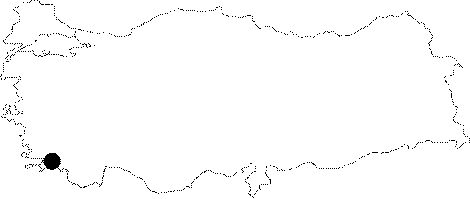 |
For photographs please click on the photo...  |
|
Type:
|
City |
|
Altitude:
|
m |
|
Region:
|
Aegean |
|
Province:
|
Mugla |
|
District:
|
Marmaris |
|
Village:
|
Merkez |
|
Investigation Method:
|
Survey |
|
Period:
|
Roman Hellenistic |
|
|
|
  |
|
| Location: It is located in the Marmaris District of the Mugla Province. The inscriptions found at the Eyliktasi Quarter (Iyilik Kayaligi) contributed to the localization of the ancient town of Physkus in Marmaris [Bean 1960:38-41]. |
| Geography and Environment: |
| History: |
| Research and Excavation: Fraser and Bean conducted surveys in 1948-50; followed by Bean and Cook in 1954. Morcol carried out a salvage excavation in the necropolis of the city in 2000. |
| Stratigraphy: |
| Small Finds: |
| Remains: The acropolis is situated on the Asar Hill; further north from the lower hill where the fortress is located. Remains of walls from the Hellenistic Period and earlier periods were found. It is concluded that it was an important city since it had a large harbor [Fraser-Bean 1954:57]. The finds other than the above mentioned inscriptions consist solely of the relief potsherds from the 2nd century BC; a portrait head from the Early Imperial Period; and some fragments of statue/relief [Anabol 1984:157-160; Bean-Cook 1957:58]. City Wall: Traces of a fortification are observed on the northwestern slopes of the Iyilik Kayaligi Hill. It was erected with polygonal technique in line with the topographical nature of the land [Morcöl 2002:157]. Necropolis/Graves: It is believed that some walls found during the researches might have bounded the necropolis. Potsherds from the 2nd and 3rd century AD were uncovered. Also found are rock cracks considered as niches by the researchers. The first niche yielded a vessel similar to an urne placed in the southwest-northeast direction while the second one revealed an in situ pithos topped by sherds including skeleton of a baby. No grave gifts were found. A Rhodian amphora with horn projection is dated to the second half of the 2nd century BC based on its form. The second niche was bounded by a thin wall in front. In a cell; which measures 1.50x0.35 m; consisting of a wall parallel to that wall and perpendicular to others; burnt soil; a layer of ashes; an incomplete unguentarium; fragments of amphoras; potsherds with coarse ware; imprinted orthogonal handle of amphora; a metalic nail; and a bone needle were uncovered. It is known that the grave niches were closed by a stone cover or by erecting a wall in front; and then plastering the external surfaces; as in the other rock burials in Caria or Caunos. It is suggested it is also valid for this niche grave [Morcöl 2002:158]. The 3rd and 4th niches contain no burials; but fragments of bones were found in the niche #4. An urne placed in north-south direction; the opening facing north was found in the niche #5. Another grave was found under the same urne. The uncovered bones belonged to infants [Morcöl 2002:158]. As a result of the excavations; eleven unguentariums with inverted rims; fat bellies; high necks; and high legs were recovered in situ. They are dated to the 2nd century BC based on their forms [Morcöl 2002:159]. Among other finds are a single handled miniature jug dated to the end of the 5th; and beginning of the 4th century BC; fragment of a black coated goblet; presumably of Corinthian origin; and fragments of black coated; footless Megara type of bowl with a semi-sphere form decorated with plant figures dated to the Hellenistic Period [Morcol 2002:159-160]. Three pithoi were found in situ during the researches at the southeastern slope of the acropolis. A wall with various sizes of stones erected on the pithoi; and the floor they were placed onto were recovered. There also niches carved into the rock. The ware of the olpe decorated with a wild goat figure in black figure technique has dense mica additives. The surface is coated by beige; decorated with dotted rosette motifs. Similar pottery is found in the burials in Rhodes and also they were locally produced in the Western Anatolia. It was dated to the first quarter of the 6th century BC. The bottom of an amphoriscos; which was used as an urne accompanied by fragment of a black firnissed; vertically plastic wedge decorated vessel uncovered inside a niche; are dated to the end of the 5th century BC. The fragment of a coated rim; with a light beige colored paste; probably belonging to a black figured crater or an aryballos; is decorated with human figures as bodies from the front; head and buttocks from the profile. The traces of black dye has been partially maintained. The details of the body and bands on the hair were highlighted with incised decorations. The figures are dated to 640 BC based on both the presence of many figures and their depiction in motion [Morcöl 2002:160-161]. Cremation and burying the dead in urnes into the carved rocks are common in the continental Greece. |
| Interpretation and Dating: |

