|
©The Archaeological Settlements of Turkey - TAY Project
|
|
|
|
|
|
Yukari Anzaf |
|
|
For site maps and drawings please click on the picture... 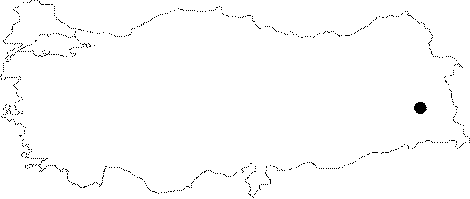 |
For photographs please click on the photo...  |
|
Type:
|
Fortress |
|
Altitude:
|
m |
|
Region:
|
Eastern Anatolia |
|
Province:
|
Van |
|
District:
|
Özalp |
|
Village:
|
Dereüstü |
|
Investigation Method:
|
Excavation |
|
Period:
|
Middle Iron Age |
|
|
|
  |
|
| Location: It is located in the Dereüstü (Anzaf) Village of the Özalp District in Van, 900 m south of the Asagi (Lower) Anzaf Fortress. It lies 11 km northeast of Tuspha, the capital of the Urartian Kingdom near the modern Van-Iran motorway and railway. |
| Geography and Environment: It has an altitude of 1995 m. It is the second highest excavation site in Turkey. The Yukari (Upper) Anzaf Fortress was founded on an area 10 times larger than the Asagi Anzaf Fortress. Unlike the Asagi Anzaf Fortress, it was a very important production center where the agricultural products were stored. The waters of the small dam built by King Menua, lying 1 km to the east played a significant role in successful agricultural activities. The Yukari Anzaf dam is still active following a few repairworks. There is no way of growing crops in the arable fields extending northwards. The Lower City, on the other hand, which is situated to the immediate south of the fortress, and enclosed by a thick wall, expands onto an area of 141.000 squaremeters. The fortress covers an area of 60.000 m2, and along with the walls and the Lower City built adjacent to the south, the area it covers reaches 200.000 m2. The Lower City which is located within the territory of the modern Dereüstü Village and which was originally planned and built along with the fortress represents one of the most important early Urartian settlements. |
| History: |
| Research and Excavation: The excavations at Yukari Anzaf Fortress which were initiated in 1991 under the direction of Oktay Belli, and continued by Oktay Belli - Alpaslan Ceylan, have been still ongoing. |
| Stratigraphy: The excavations at the Yukari Anzaf Fortress yielded two building levels. The lower level contains the Iron Age material, and the upper level is from the Middle Age. In addition to the Middle Iron Age sherds, glazed, green, yellow colored Middle Age sherds were found. The Iron Age remains have been disturbed by the Middle Age. |
| Small Finds: Architecture: Unlike the fortifications of the Asagi Anzaf fortress, the walls that surround the Yukari Anzaf Fortress were built using curtain walls and bastions. With a monumental appearance, the walls represent one of the best examples of the early Urartian fortification walls. The millions of cubic meters of calcareous stones used for the defence walls surrounding the fortress and the lower city, and foundations of the temple, storage buildings, palace, and other buildings were derived from the quarry and workshop called "Beyaztas Tepe", lying 300 m to the south of the fortress. The Yukari Anzaf Fortress is also one of the most important cult centers of the Urartian kingdom. The earliest temple in a square plan, which was dedicated to the national god of the kingdom, Haldi, is located in the Yukari Anzaf Fortress. Furthermore, several types of monumental rock signs were carved onto the leveled surfaces of the rocks to the east and northwest of the fortress. The 22 signs which were carved very elaborately on the surfaces of the rocks symbolize that the fortress was consecrated. None of the fortresses built during the Urartian Kingdom period has such rich and monumental rock signs. They suggest that the Yukari Anzaf Fortress may have been an important religious center. East Gate of Lower City: All three sides of the Asagi Kent (Lower City) were surrounded by a 2 m thick wall, combining with the southern wall of the Anzaf Fortress rising to the north. Obviously a town that expands onto such a large area should have had more than one gate. It is likely that they were piercing the western, northern and eastern walls. The 4.30 m wide East Gate provided significant data on the shape, size and construction technique of the city gates in Eastern Anatolia. Just like the northern gate at Karmir Blur in Transcaucasia, it consists of a space between the two walls. It seems that the gate had two wings opening inward. It was built during the reign of King Menua together with the fortress and the Lower City. Storage Buildings: Many storage rooms were built side-by-side adjacent to the west wall of the fortress. It appears that they were two-storey buildings. The storage rooms which were built side-by-side were divided by a wall of 4 m in avearge from each other. Absence of any door opening in any of the 5 rooms indicates that they were accessed from the first story by a ladder. Elaborately built with whitewashed walls and a floor of compacted clay, one of these rooms was used as a kitchen and the others as storage rooms. A hearth and an oven uncovered in the southwestern corner of the square room suggest that it was used as a kitchen. The excavations resumed inside the storage rooms in 2004 and primarily the rooms were enumerated from west to east. Hall nr 11: As in other rooms' walls, the walls of this very large hall were built with stone foundations and adobe was used above this. The south wall of the hall was plastered with white lime and it contains four niches lines back-to-back. The hall's floor cover was built of pressed clay. Two of the four column pedestals in the center of the hall are in situ. It is believed that the room adjacent to the south wall was used as a storage room. The large hall covers an area of 300 m2 [Belli 2006:154-156]. Main Hallway nr 10: this hallway is 44 m long, and it is possibly the main hallway. It lies in north to south direction and it opens inside the large hall [Belli 2006:154-156]. Pillar Hall Nr 14: It is a square planned hall [Belli 2006:154-156]. The section that was named plain "hall" the previous year, was renamed, and called "Pillar Hall" this time, due to the pillars that support the roof, which was excavated during the 2005 campaign. The pillars are not located in the center, but they are closer to the north wall, lie in east-west direction, and have a rectangular form. The foundation sections of these four pillars consist of stones and the upper portions are made of adobe. The hall covers an area 192 m2 in size [Belli 2007:416-418]. During the analysis performed in this hall in 2006, it was found that the pithoi contained sesame oil [Belli 2008:178-179]. Hall nr 12: Has a rectangular form and it possibly was built as a mezzanine for workers. There is a hearth built with flagstones [Belli 2006:154-156]. Hallway nr 13: It is the section lying in east direction that belongs to hallway nr 10, that makes a 90 degrees angle at 46 m.. It has an overall length of 38 m [Belli 2006:154-156]. Large Reception Hall 15: It composes the nearest room to Haldi Temple immediately south [Belli 2007:420-422]. Three column pedestals were found at a location near the room door during 2006 excavations. Two of these that stand side by side are in situ. There are two morecolumn pedestals to the south of these. One of these is also in situ. Two of the pedestals contain inscriptions. These inscriptions found for the first time at Yukari Anzaf Fortress read "Menua, son of Ishpuini, has built this palace perfectly". These inscriptions show that the hall and rooms assembly north of Khaldi temple courtyard belong to the palace. Obviously these palace buildings date to 9th century BC similar to the temple[Belli 2008:180-183]. The actual access gate for the Reception Hall is in northwest direction. It has a 2 m depth and its width is 2.5 m. It shows that the road from Southwest Gate protected by Great Tower in the northwest, enters from the northwest gate of Great Reception Hall. The column pedestal number found during 2007 excavations are 10. 7 of these are in situ'dur. The number of the ones containing inscriptions is five. Apparently the hall roof was built using wooden beams placed vertically and horizontally. The area of the hall as of year 2007, is 238 m2 [Belli 2009:452-458]. Room nr 16: Located north of Pillar Hall 14. Apparently the rectangular planned room was very large [Belli 2008:183-184]. Four column pedestals were unearthed during 2007 excavations 40-50 cm below the floor level. The wooden beam rising above the column pedestal was pressed around with small stones at floor level, and the wooden beam was reinforced [Belli 2009:458-459]. Hall nr 17: It was built adjacent to the northeast corner wall of the Great Reception Hall. It contains two doors, and one of these is on the Great Reception Hall side, and the other is across from this one. The rectangular planned room lies in east-west direction [Belli 2009:460]. Big Tower, North and South Gates: The monumental-looking North and South gates and the Big tower which provides defence for them are in the southwestern walls of the fortress. Both gates were built at very sheltered spots, even being kept away from the gusty east wind. Another feature of the gates is that they are not noticed when looked from the west. So, both gates were hidden well. It is obvious that these two gates, being reinforced by a monumental tower, were important. An almost square tower of 11x8 m was built on the northern surface of a very large rock mass, and then the eastern part of the tower was connected with the bedrock. This monumental and impressive tower has an average height of 7 m above the ground level. However, it seems that it was originally higher. The tower was built with elaborately dressed large limestone blocks. So far, this interesting tower is the earliest of the Urartian towers, protecting the citadel gates in existence. To the south of the tower is a triangular open courtyard that provides access to the south gate. The courtyard has been completely destroyed at present. The North Gate which looks rather monumental compared to the South Gate, is located next to the north façade of the tower. The east wing of the gate obviously was planned along with the tower. It appears that the region suffered a big earthquake during the 7th century BC, and the buildings of the fortress were seriously affected. Kitchen Buildings: These rooms so called as storage and kitchen buildings are located to the northeast of the Haldi temple, east of the storage #5. They have been destroyed to a great extent. The northern and southern kitchens are divided by a separation wall of 2.5 m wide, and 3.5 m high. The kitchen which is located to the north of the separation wall, measures 5x21 m in dimensions, and it has a rectangular plan. A total of 9 tandoors and 2 pithoi were unearthed at several locations in the northern kitchen. In addition to many sherds, numerous crushing stones and stone vessels were found. Among the metal objects and weapons are iron knives, fishhook and an iron bullion. Magazines with Pithoi: They are located 16 m southeast of the kitchen buildings. They are approximately 1975 m high above the sea level. Both rooms have a rectangular plan, measuring 4.5x10 m in dimensions. The western room yielded 12 pithoi buried up to their necks, 1.5 m under the ground in the west room. Thirteen pithoi were found in the other room. Temple and North Buildings: The temple was dedicated to Haldi, the national god of Urartians, and it is located at 1995 m in the southern section, which has the highest altitude of the fortress. The floor of the temple with a square plan that measures 13.40 m in dimensions was obtained by leveling the bedrock. The wall thicknesses at the temple is 2.5 m with corner risalits as in the other Urartian temples. The north gate of the temple faces the gorgeous Süphan Mountain. Unfortunately the temple and the courtyard had been badly destroyed due to a large reoccupation during the Middle Age. Only the eastern wall has survived to the present day. On the northeastern corner of this wall, there is a construction inscription of the temple. Unlike his other inscriptions, King Menua never mentions his military campaigns in this inscription, which indicates that the fortress was built during the early years of the Urartian Kingdom. The temple of the Yukari Anzaf Fortress represents the earliest Urartian temple known so far. The courtyard and rooms in the western section of the temple can be accessed through a long corridor carved into the bedrock. The present length of the corridor is 9.5 m. Pottery: The excavations yielded many sherds, intact vessels, bowls, jugs, red burnished and slipped plates, pithoi, trefoil mouth jugs, and rhyta dating to the Urartian Period. The finds clearly bear characteristic features of the Urartian pottery. Also found are sherds of glazed ware from the Middle Age. The red coated rhyton found during 2004 excavations was reconstructed and it belongs to a bull. It was dated to 7th century BC. It has a very elaborate craftsmanship [Belli 2006:157]. On four pithoi found inside the Pillar Hall 14 during 2005 excavations there are no cuneiform inscriptions, stating the amount of the nutrition in liquid form and the beverages, and three of the pithoi contained measures on them [Belli 2007:421]. A very large pithos was found in front of the Great Reception Hall nr 15 during 2007 excavations. This pithos contained either water or wine inside [Belli 2009:455]. Small finds: Among the iron weapons and objects dedicated to god Haldi stored in a small room of 8 squaremeters are knives, arrowheads and javelin heads in various sizes. Among the bronze objects and weapons are fibulae, helmets, cheek- pieces of helmets, votive rings, shields, and shield handgrips, discs, armors, armor plates, harness gear, jointed bracelets, arrowheads and hundreds of bronze plates with unknown function. A bronze arrowhead with double blade and spur recovered from this room is an important evidence of destruction by the Scythians. Iron rings on walls, bronze and inscribed rings on doors and plain bronze rings on doors were revealed in 2004. The bronze, inscribed door ring that belonged to Sarduri II is the oldest among such inscribed bronze rings [Belli 2006:157-158]. Interesting finds were found during 2005 excavations. The medicine vessels found inside Pillar Hall 14 were found at Karmir-Bur excavations north of Aras River as well. One of the oil-lamps found inside the same hall, has a mouth diameter of 27.6, and a height of 11 cm, and these dimensions make it the largest found inside the fortress. Besides this, an iron and a bronze chisels inside the fortress [Belli 2007:422-423]. The most interesting find of 2006 excavations is a couple of bronze vehicle wheels unearthed underneath Hall nr 15 floor. These wheels were made with bronze cast technique, and are identical. Both contain six wheel rims, and possibly these wheels belong to a miniature war carriage. It is assumed, that these belong to King Menua period (810-786 BC) [Belli 2008:184-185]. One of the most interesting finds of 2007 excavations is the fragrance container found inside room 17. Its shape is a very tiny amphora without handle. Another find is the bronze thimble was also made with cast technique, it is similar to the ones presently produced, and it is the first of such specimens. The most authentic find is the bronze loomweight found on the floor of Great Reception Hall nr 15. The bronze articraft produced with massive casting technique weighs 35 kg. An animal head motif, a tall tower motif and five rosette motifs were worked as reliefs on one side of the bronze loomweight by scraping/striking technique. It is assumed that these signs are pictographs. The shorter handle contains another cuneiform inscription consisting of 9 syllables. The inscription has not been decyphered yet [Belli 2009:462-463]. |
| Remains: |
| Interpretation and Dating: Such rich and monumental rock signs as in Anzaf have been seen in none of the fortresses built during the reign of King Menua. Considering absence of any monumental rock signs in the Urartian capital Tushpa, and near Meher Kapi, it is easy to understand the importance of the Yukari Anzaf Fortress as a religious center. Additionally the unique Urartian god depictions on a votive shield recovered from the small room where the weapons, and other items dedicated to god Haldi were stored suggest that the fortress was a cult center. One of the most important characteristics, that differs Yukari Anzaf Kalesi from other Urartu fortresses is primarily its location which constantly became subject to many settlements, and the need for constant expansion. The fortress reflects Urartu fortress architecture between the last 10 years of 9th century BC to late 7th century BC [Belli 2007:415]. |

