|
©The Archaeological Settlements of Turkey - TAY Project
|
|
|
|
|
|
Selçikler Tümülüsleri |
|
|
For site maps and drawings please click on the picture... 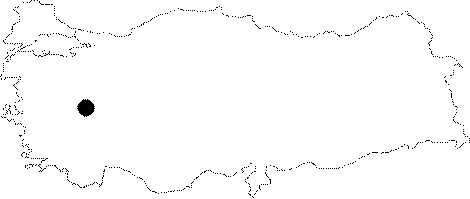 |
For photographs please click on the photo...  |
|
Type:
|
Tumulus |
|
Altitude:
|
m |
|
Region:
|
Aegean |
|
Province:
|
Usak |
|
District:
|
Sivasli |
|
Village:
|
Selçikler |
|
Investigation Method:
|
Excavation |
|
Period:
|
Archaic |
|
|
|
  |
|
| Location: It is situated on Selçikler-Tatarlar road where the Tepe Quarter of the Selçikler Village is located at, 2 km southwest of the Sivasli District in Usak. There are three tumuli in this area so called T-1, T-2 and T-3. |
| Geography and Environment: The high plateau on which the tumuli rise is being irrigated by the Banaz Brook, one of the tributaries of Gediz and by the tributaries of Menderes River in the upper basin area. |
| History: |
| Research and Excavation: It was investigated by means of soundings, surveys and excavations by U. Esin between 1966 and 1967. And, the excavations conducted under the direction of N. Firatli in 1966 were published in the form of bulletins, notices and excavation reports. |
| Stratigraphy: |
| Small Finds: Architecture: Tumulus T-1: With a northeast-southwest oriented main axis, the grave consists of a dromos and a grave chamber. Some of the large clamped cutstones composing the lateral walls of the dromos were removed, resulting in complete destruction of the opening. The height of the walls can only be identified depending on the existing traces on the frame of the door, which also allows to suggest that the ceiling of the dromos was of straight lintels with a height reaching up to 2 m. The floor, which was made of compressed soil, enlarges from the grave chamber toward the entrance of the dromos. The grave chamber has an almost square plan, constructed with local stones. It has a saddle roof covered with two monolith stone blocks. The floor was paved with two monolith slabs as well. The entrance of the grave chamber was closed by a stone lid, which is not available anymore. But the dimensions can be obtained from the knobs on the frame. An elaborate stone masonry of three courses of local limestones is observed in the grave chamber. No clamps were used between the stones. The masonry of the dromos is less elaborate, and also clamps were used. Tumulus T-2: It was believed that this almost 10 m high and 55 m wide tumulus to the east was not disturbed before the archaeological excavation started. On the contrary, the robbers disturbed the grave chamber 3 to 5 times, and collected all available finds, breaking the floor pavement and the kline. Still, the grave bears the most distinctive grave architecture of the region. The main axis of the grave is northwest-southeast oriented. It consists of a rectangular main chamber, two anterior chambers, and a dromos. In front of the dromos is a 1.7 m wide crepis consisting of one course of regular rubble stones. It was probably built only for protection of the entrance to dromos. The dromos and the two anterior chambers are not in the same axis, the grave lies out of the axis. Topped with a saddle roof, the entrance to the dromos was covered by a lidstone consisting of two slabs. The top of the grave chamber and the two anterior chambers, which are lower in height, were covered by stone beams. The slabs set in relieving triangles should have been put in order to minimise the burden of the pile of earth on the grave chamber. The grave chamber and the 1st anterior chamber are superior to the other parts of the grave in terms of both the masonry and the material, i.e. marble. The floor of the grave chamber and the 1st anterior chamber were made of cut stones while the 2nd anterior chamber and the dromos were paved with compressed soil. Although details of the kline are not available as the burial chamber was robbed and the kline was broken, the dimensions can be estimated based on the traces on the walls and available parts. The main kline is across the entrance of the grave chamber. There is a narrower bench on the side, probably used for placing the burial gifts. The kline was built so that one side strecthes into the gutter on the wall, and on the other side it touches the floor. Traces and parts of the doorslab into the grave chamber and the 1st anterior chamber were uncovered. The double winged marble door of the grave chamber opening inward (K1) gets narrower towards the top. The traces on the threshold and the hole marks on the lentil indicate that the door was seated on sockets on the upper and lower sections. Such four-piece marbe doors imitating wood decorated with iron nails are common in the region. The door of the 1st anterior chamber that opens inwards (K-2) is not within a frame, but is in front of it. The door has two wings made of stone instead of marble. Sockets are observed in two corners. Over the doorjamb, there are no sockets but holes for inserting corner profiles. The walls of the grave chamber and the 1st anterior chamber were built of marble ashlar blocks, the surfaces being smoothed by a scraping tool. The blocks of the grave chamber were connected by clamps. All clamps were broken by robbers, therefore no information is available about their types. The large blocks superimposed on each other in the 1st anterior chamber have an elaborate masonry while the local blocks of the 2nd anterior chamber are less elaborate, edges of each block being dressed properly in a fine frame. The surface of the stones in the dromos and the 2nd anterior chamber were left coarse. Tumulus T-3: The large tumulus lying to the west has a diameter of 75 m and a height of ca. 21 m. The grave chamber was disturbed through a tunnel opened by the robbers. It consists of a grave chamber and a dromos. With an almost rectangular plan, the grave chamber was topped with flat blocks. A stonelid covers the area between the dromos and the grave chamber. The ceiling of the dromos is also topped by horizontal blocks. Pottery: During the excavation in the dromos of of Tumulus T-1, sherd of a Lydian vessel was found under the floor. |
| Remains: |
| Interpretation and Dating: Absence of any finds in the tumuli at Selçikler Village hinders dating of the graves. However, the Persian influence [Mellink 1967:172] observed on the finds recovered from the neighbouring mound at Güre-Ikiztepe Tumulus, which is similar to the Selcikler Tumuli suggests that these tumuli may be dated to the same period [Mellink 1967:172]. Both their similarity to the grave chambers of the Lydian tumuli and presence of other grave chambers bearing Persian features in the neighbourhood may be interpreted as they belong to the Greco-Persian culture, which was common during the 5th century BC. |

