|
©The Archaeological Settlements of Turkey - TAY Project
|
|
|
|
|
 |
Kuleler Kale |
|
|
|
|
For site maps and drawings please click on the picture... 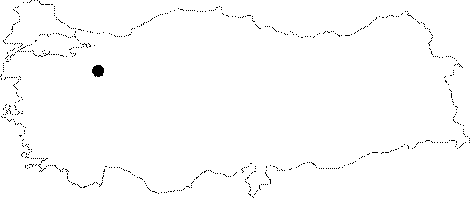 |
For photographs please click on the photo... 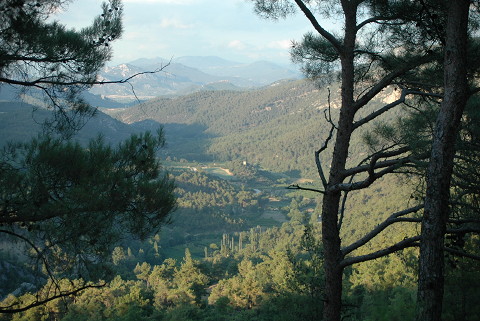 |
|
|
|
|
Type:
|
Fortification |
|
Plan Type:
|
|
|
Year of Costruction:
|
|
|
Phase:
|
Middle |
|
Investigation Method:
|
Survey |
|
Altitude:
|
127 |
|
|
|
|
Region:
|
Marmara |
|
Province:
|
Bilecik |
|
District:
|
Osmaneli |
|
Village:
|
|
|
Antique Name:
|
|
|
|
|
  |
|
| Location: It is located on a slope where the valley of Göksu becomes wider near the shore of the Yenisehir River to the west of the Osmaneli District in the Province of Bilecik to the east of the Iznik District of Bursa [Giros 2003:218]. |
| Geography and Environment: The fortress overlooks a small and arable valley, a river, and a lower road in the Göksu Valley [Foss 1986:156]. |
| Research and Excavation: It was first studied during the survey of C. Foss. Later on, C. Giros worked on the remains, and examined its masonry in detail, and drew a plan of the building [Foss1986:156; Giros 2003:217, pic.3]. |
| Description: Architectural Features: The extant remains of the fortress, called Towers or the Double Towers, include two semicircular towers which have been well preserved, and a very small part of a wall. The dimension of the towers, which Foss described as "open-gorge towers", is pretty small: the eastern tower's diameter is 3 m, and the western tower's is 4.5 m [Foss 1986:156; Giros 2003:217]. It was found out that the walls were reinforced by wooden ties. The wall was erected with rubble stones, alternating with courses of pink marbles. The towers consist of three storeys divided by wooden floors. Wall remains are observed at the center of the slope, on the northern and southeastern sides, and between the two towers which are 60 m apart. |
| Finds: Pottery: V. François dated the surface finds of potsherds to the Lascarid Period. In the mean time, as a result of the radiocarbon method applied on the mortar sample, which was taken from one of the towers, it was dated to the same period, between 1045-1260, or at most to the year 1118 [François 2003:301-302]. |
| Interpretation: |
| Destruction: It is observed that the south of the east tower and east of the west tower were demolished. None of the two building covers survived to date. But both towers were well preserved. Illicit digging was performed outside the west tower. There are east-west lying wall remains on the west side of the east tower and an illicit digging was performed there as well. These wall remains can partially be followed. Wall remains can be traced at intervals on ground level towards the southwest. Terracing was performed here [TAYEx 17.07.2008]. |

