|
©The Archaeological Settlements of Turkey - TAY Project
|
|
|
|
|
 |
Kite Kalesi |
|
|
|
|
For site maps and drawings please click on the picture... 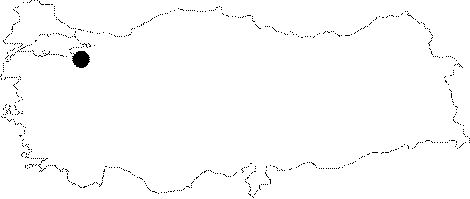 |
For photographs please click on the photo... 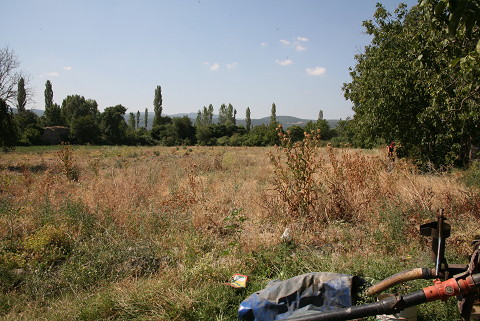 |
|
|
|
|
Type:
|
Fortification |
|
Plan Type:
|
Polygonal |
|
Year of Costruction:
|
13th c. |
|
Phase:
|
Middle |
|
Investigation Method:
|
Survey |
|
Altitude:
|
75 |
|
|
|
|
Region:
|
Marmara |
|
Province:
|
Bursa |
|
District:
|
Nilüfer |
|
Village:
|
Ürünlü |
|
Antique Name:
|
|
|
|
|
  |
|
| It lies on a plain ground to the southwest of Ürünlü (Kite) Village, 16 km to the west of Bursa. The location of the building is known as Kaledibi Mevkii and the Ayvali Stream flows on the east side of the building. The location of the fortress was registered as 2nd degree preservation zone. It is inside a land of approximately 23 sq. km. The east wall of the fortress can be traced up to a length of 25 m. Planted fields are located west of the east wall. The south wall can be traced up to a length of 50 m. There are wall remains west of the fortress approximately 6 m in length. Based on the information that Hasluck provided there are no traces of the towers. Many tile fragments, glazed and sigrafitto decorated sherds were collected around the fortress [TAYEx 10.07.2008]. It was found and briefly described by F.W. Hasluck in the early 20th century [Hasluck 1906-1907:300]. It was later investigated by C. Foss, and then visited by C. Giros in 1990 who conducted a survey in the region [Foss-Winfield 1986:156; Giros 2003:222]. The longest side of the irregular polygonal fortress is the western wall, which measures 135 m. It has been well preserved on the southeastern section, and it was erected with courses of stones and bricks, attached with white mortar. It has a thickness of ca. 2.4 m [Giros 2003:221]. Hasluck identified many towers with different plans (hexagonal, triangular, horseshoe, square) in the early 20th century, but they are hardly noticeable at present. Based on Hasluck's photographs, the large hexagonal tower stood on the southwestern corner of the fortress. The ceramic finds are dated to the early 14th century [François 2003:301]. The location of the fortress was registered as 2nd degree preservation zone. It is inside a land of approximately 23 sq. km. The east wall of the fortress can be traced up to a length of 25 m. Planted fields are located west of the east wall. The south wall can be traced up to a length of 50 m. There are wall remains west of the fortress approximately 6 m in length. Based on the information that Hasluck provided there are no traces of the towers. Many tile fragments, glazed and sigrafitto decorated sherds were collected around the fortress [TAYEx 10.07.2008]. |
| Location: |
| Geography and Environment: |
| Research and Excavation: |
| Description: |
| Finds: |
| Interpretation: |
| Destruction: A concrete wall that lies in north-south direction was added to the west wall. The fortress is among planted fields. The heavy destruction caused by field plantation and vegetation caused demolishments and cracks on the walls [TAYEx 10.07.2008]. |

