|
|
||||
|
|
||||
 |
Incirli Gök / Suluin |
|||
|
For cave maps and drawings please click on the picture... |
For photographs please click on the photo... |
|||
|
 |
|||
|
Type: |
Vertical Cave | |||
|
Altitude: |
m | |||
|
Depth: |
- 64 m | |||
|
Length: |
115 m | |||
|
Region: |
Mediterranean | |||
|
Province: |
Antalya | |||
|
District: |
Finike | |||
|
Village: |
Merkez | |||
|
|
||||
  |
||||
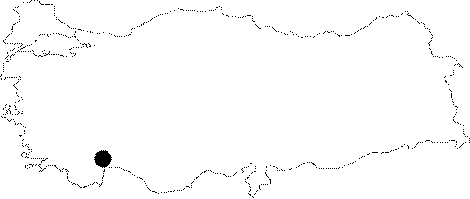
| Location: It lies to the north of the road; 1 km far from Finike on the Finike-Kas motorway. |
| Structural Properties and formation : It was developed on a fractured zone within the Upper Cretaceous limestones; which are massive; highly pure and gray colored. The pit at the end of the cave is filled by sea water [Güldali et al. 1991:16]. |
| Research History: The MTA report in 1991 provides a total length of 128 m [Güldali et al. 1991:16]. The siphon was dived until -64 m; and reported to continue much deeper [Couturaud-Wolozan 1991:20]. |
| Findings: Rescue excavation continues [Taşkıran-Aksu 2011:36]. During the continuing rescue excavations in 2008 it is observed that Geologic Level 1 soil is black because of plenty of burned charcoal pieces and dust in modern times; Geologic Level 2 soil is brownish, and Geologic Level 3 soil is lighter brown compared to the upper layers. All of the geological layers belong to Holosen Period, and Pleistosen period could not be reached during 2008 excavations as well. When the entire excavation area is considered the intensely rubbed limestone which are observed in archaeological layers 3 and 4, and doesn't show a regular pattern, started to have a pattern in archaeological layer 5, and on the base of archaeological layer 6 they are used in the walls that surrounds some rooms. The most intense row of such stones reach from Southeast of the trench to its Northwest. In the Southwest of this wall a small location is unearthed which is approximately 2 by 1 m and surrounded by stone rows. Adobe plates that are encountered on the surface of this location (named as "Location A") were sun dried or improperly baked. Two of these plates have holes. It is believed that this location is used as a storage area or workshop rather than a living area. The most similar location to this site the one unearthed in Höyüzek excavations in Bucak Suburb. A base is unearthed named "Location B" in the North-Northeast of the wall remains made of pressurized granular limestone and pottery. Usually monochrome pieces of pottery that belong to Late Neolithic Ğ Early Chalcolithic Age are captured from the archaeological level 4 to 6. The most important finds of 2008 are a steatite stamp seal and an item made of steatite whose function is not yet understood but possibly an ornament found in the archaeological layer 3 believed to belong to Chalcolithic Age. Blades, bladelets, and related core pieces constitute the most common materials among the pebble stone materials found. Two of the core pieces which are bullet-like are made of flint stone, one is made of obsidian. Chisel pointed arrow-heads show that bird hunting is an intense occupation in the cave [Taşkıran-Aksu 2011:37-40]. |

